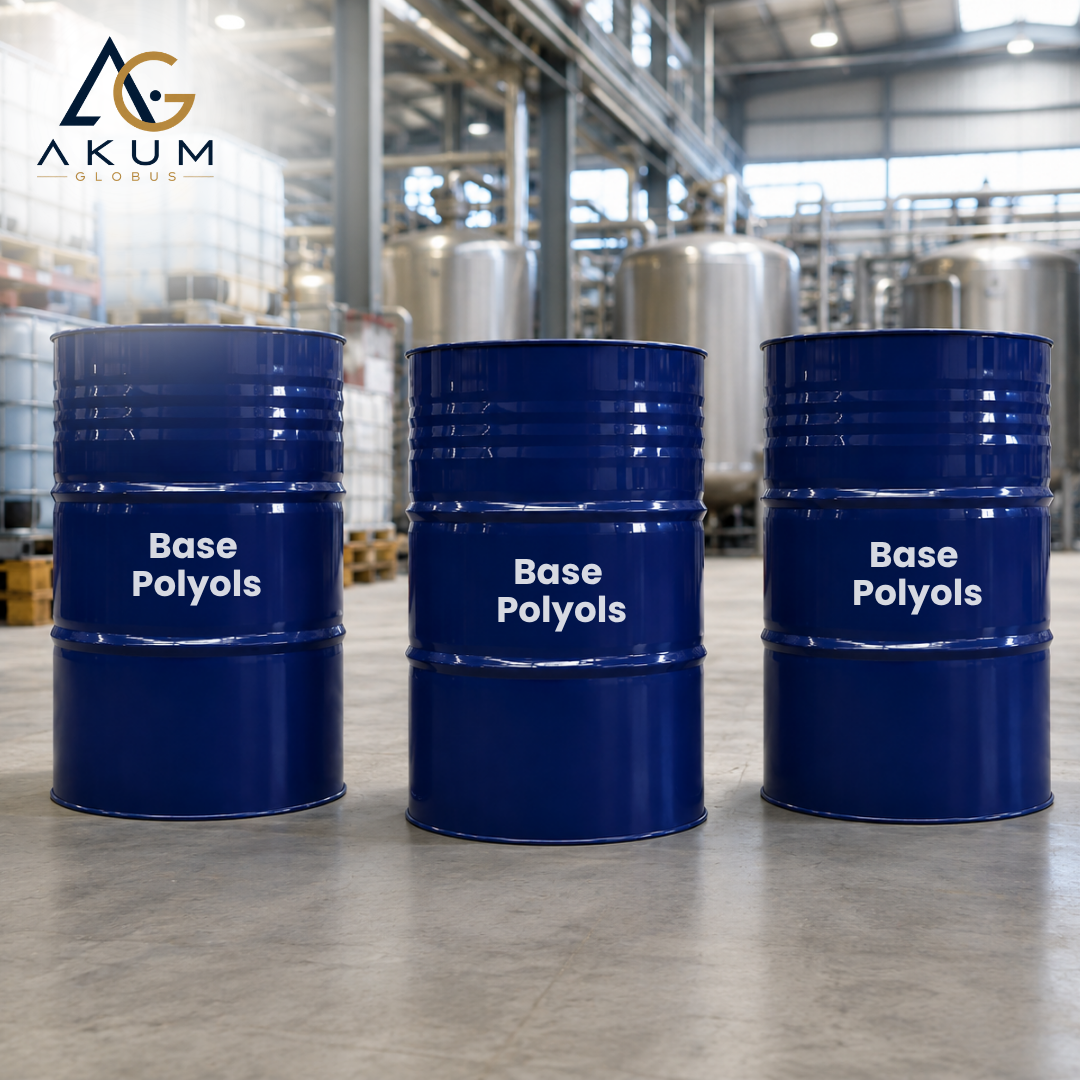

Blend Polyols arrive as a prepared combination of polyol, catalyst and surfactant, so a foam producer can run a known recipe without weighing every component at the reactor. Blend ratio, hydroxyl value, viscosity and shelf stability are fixed together, and the catalyst balance is already inside the drum. Akum Globus Pvt. Ltd. supplies these systems in drums and IBCs to manufacturers who want one specification across a repeating schedule. Most producers who shortlist top rated Blend Polyols manufacturers are trading a little freedom for consistent blended foam.
What has to be fixed in a blend so that mattress foam and rigid panel foam can both run from the same supply agreement? Not one blend but a documented family. Each grade needs its own hydroxyl value, catalyst balance and viscosity band, while commercial terms, packing and paperwork can be shared. A single blend pushed across both products will cream too fast for a panel cavity or set too hard for a mattress core. A blended polyol family keeps each grade separate and each approval intact.
Can a blend be matched to an existing foam grade when a producer changes line speed or mould geometry? Yes, within the tolerance of the existing approval. A faster line usually needs a slightly delayed catalyst so the mix reaches the end of the cavity, and a deeper mould may need more surfactant to fill the corners. The change is made at the blending stage rather than on the plant floor, and a trial batch confirms the new figures. That is what blend matching to grade means in practice.
A blend removes the daily weighing step and leaves the producer with one specification to approve, one batch record to file and one delivery to schedule. That simplicity is worth more on a busy line than a theoretical saving from buying each component separately. Producers who rely on best Blend Polyols suppliers keep the grade list short and the records clear, so a change in the foam can be traced to a change in the blend.
Is a blend worth more than the sum of the components it replaces? On a line that repeats one grade, it usually is, because the weighing step disappears from every shift. A producer comparing top rated Blend Polyols manufacturers with the best Blend Polyols suppliers should check whether the ratio, the hydroxyl value and the viscosity are held steady from drum to drum.
Ratio Fixed at Blending : The polyol, catalyst and surfactant ratio is set at the blending stage, so an operator opens one drum instead of weighing three components, and the fixed blend ratio removes a scale error from every shift.
Hydroxyl Value Matched : The hydroxyl value of the blend is matched to the foam grade it serves, which keeps reactivity and hardness on target without a fresh calculation at the plant, and a matched hydroxyl value is what makes the grade repeatable.
Viscosity Held Stable : Viscosity is controlled so the blend meters and mixes the same way through the pump, the flow meter and the head, even when the line runs at a different rate, and stable blend viscosity keeps the pour even.
Catalyst Balance Inside : Cream, rise and cure are set by the catalyst already in the blend, so a producer needs no separate addition and no second dosing point, and the built in catalyst balance protects the cycle time the plant has planned.
Shelf Stability Checked : Each blend is checked for separation and drift before dispatch, because a system that settles in storage gives a different foam from the one approved in the trial, and blend shelf stability is tested rather than assumed.
One grade, one dose and one record simplify a shift, and they also make a production problem easier to trace. A plant weighing top rated Blend Polyols manufacturers against the best Blend Polyols suppliers should ask for the ratio behind each lot, because that ratio is what turns a foam fault into a batch reference.
Blended systems suit producers who want to protect a proven foam grade without running a full formulation laboratory. Mattress blocks, rigid panels, moulded parts, spray foam and shoe sole systems each take a blend built for its own reactivity, and the plant job narrows to metering, mixing and curing. Makers who keep a small family of grades usually buy from top rated Blend Polyols suppliers.
Mattress Foam Blocks : A blend for mattress foam carries the catalyst and surfactant needed for a soft, open cell and a stable block height, so the line repeats the same feel without re-dosing, and mattress foam blending keeps the block height within the cutting plan.
Rigid Panel Cores : Panel blends favour a quick cream and a fine closed cell, which helps the foam reach the far edge of a cavity and bond to the facing before it gels, and rigid panel foam blends are chosen against the cavity depth.
Moulded Foam Parts : A moulded blend is balanced for fill and demould, so complex shapes release cleanly and the cycle stays inside the plant pattern without an extra catalyst, which is where moulded foam cycle time is won or lost.
Spray Foam Coats : Spray blends hold an open time long enough for an even pass and cure quickly enough for trimming in the same shift, keeping a contractor day predictable, and spray foam blend selection follows the ambient temperature.
Shoe Sole Systems : Shoe sole blends are formulated for density, abrasion and flex, and the catalyst balance is set so a thin sole fills without voids or surface defects, which is why shoe sole system blends are trialled in the actual mould.
Each product asks for a different balance, and the blend is where that balance is held. Producers who settle it once tend to keep the same grade on the schedule for years, and top rated Blend Polyols manufacturers make that kind of continuity possible.
Would a plant rather weigh three components on every shift or approve one specification once? The answer depends on how much the line repeats, and a blend rewards repetition. Buyers who compare top rated Blend Polyols manufacturers with the best Blend Polyols suppliers look for a documented grade list, drums or IBCs that match consumption, and a ratio confirmed before dispatch.
One Drum One Dose : The operator doses a single material instead of three, which removes a weighing error, a spill and a cleaning step from every shift, and single drum dosing keeps the reactor area clear.
Ratio Held Batch to Batch : The blend ratio is recorded and repeated for each lot, so a grade approved in January still produces the same block later in the year without an adjustment, and batch to batch ratio control protects the approval.
Packing for Weekly Use : Drums and IBCs are supplied against the consumption a plant reports, so a producer is not pushed into a bulk purchase it cannot store or use within the month, and weekly consumption packing keeps stock moving.
Change Controlled at Source : When line speed or a mould changes, the blend is adjusted at the blending stage and re-trialled, rather than patched with extra catalyst on the floor, so a controlled blend change leaves the operator routine untouched.
Records for Every Grade : Each grade carries its own ratio, hydroxyl value and batch reference, which gives a quality team a clear trail when a customer asks how the foam was made, and grade specific records make an audit straightforward.
A consistent blend makes the rest of the plant decisions simpler, from scheduling to quality release. Producers who keep top rated Blend Polyols manufacturers and the best Blend Polyols suppliers on the same grade through a product change get the benefit of a documented ratio, and that record is what a plant actually buys.
Send the foam grade, the monthly volume and the delivery details to [email protected], with the line speed and the mould or block size if the grade is new. The offer states the proposed ratio, the trial quantity and the packing. The ratio, the packing and the delivery date are confirmed in writing before the blend is made.
Explore our range of polyurethane chemicals and specialty solutions developed to support efficient processing, formulation flexibility, consistent quality, and reliable industrial performance.
Copyright © 2026 Akum Globus Pvt. Ltd.. All Rights Reserved. Designed By HD Smart Media